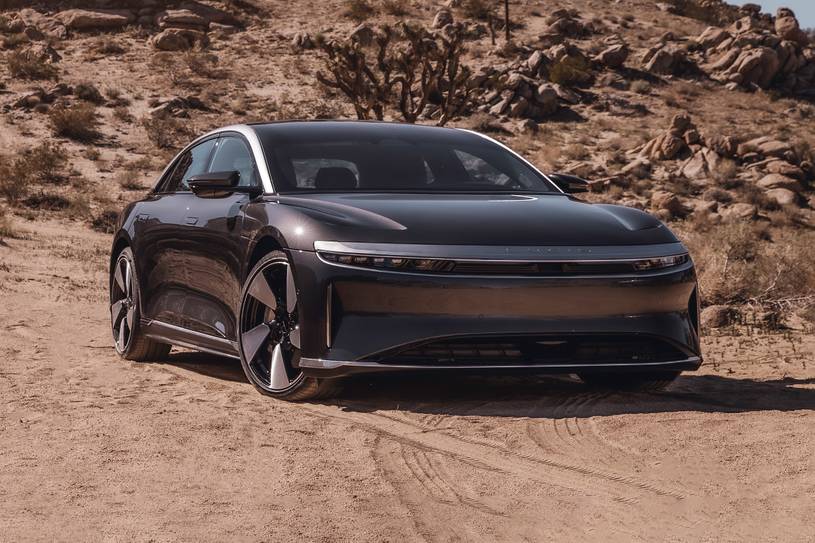
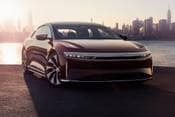
The Lucid Air is the first vehicle from this new American electric vehicle manufacturer. It debuted last year and generated plenty of hype. First, there's the power: potentially more than 1,000 horsepower. Then there's the maximum potential range: more than 500 miles on a full charge. Oh, and did we mention that it's a spacious luxury sedan packed with technology features, too?
For 2023, Lucid is adding to the Air lineup with the Air Sapphire, a performance-oriented variant that targets the Model S Plaid's drag-strip crown. Complete details on the Sapphire have yet to be released by Lucid, but the company says this three-motor, torque-vectoring version of the Air will produce more than 1,200 horsepower. On a drag strip, that will potentially enable the Air Sapphire to rip from 0 to 60 mph in fewer than 2 seconds and clear the quarter mile in fewer than 9 seconds. Lucid also equips the Sapphire with high-performance suspension, brakes and tires to complement the extra power.
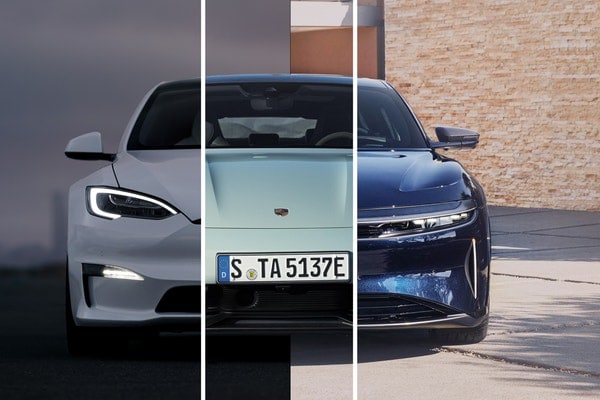
Of course, not everyone needs (or can afford) a 1,200-hp luxury EV. That's why we're actually more interested in the lower-cost Air models that are finally being delivered for the 2023 model year. The Air Pure and Air Touring are the ones we think you'd want to consider as rivaling the BMW i7, Mercedes-Benz EQS, Porsche Taycan and Tesla Model S to be your next luxury EV. Check out our Expert Rating below to get our test team's in-depth report on the Air's performance, comfort, real-world range and more.
What's it like to live with?
It's an interesting experience, to be sure. Our test team bought a $140,000 Lucid Air Grand Touring to join our long-term test fleet. Check out our Lucid Air long-term road test to read what our car experts like (and don't like) about driving an Air for a year and 20,000 miles. You can also see a few videos starring our Lucid Air on Edmunds' YouTube channel.
Edmunds Expert Rating
Our VerdictThe Edmunds Vehicle Testing Team evaluates a fresh batch of vehicles every week, pairing objective assessments at our test track with real-world driving on city streets, freeways and winding roads. The data we gather results in our Expert Ratings. They’re based on 30-plus scores that cover every aspect of the automotive experience.
The Lucid Air is a solid first effort from a brand-new automaker. It's insanely quick, spacious and is capable of driving farther on a single charge than any other EV on the market. But it's far from perfect. We've encountered some issues with the car's technology features and overall build quality, both of which might damper one's expectations for a stress-free ownership experience.
Rated for you by America's best test team.How does the Air drive? We've tested a few Air versions, including the 2022 Air Dream Edition Range and a Grand Touring. In Edmunds' testing, the 933-hp Dream Edition went from 0 to 60 mph in blindingly quick 2.8 seconds. That's quicker than most vehicles we've tested. The Air's quarter-mile time, in case you're interested, was 10.3 seconds at 132.2 mph. The Grand Touring we tested was slower but still outrageously quick by most measures, needing 3.2 seconds to sprint to 60 mph.
The major performance-limiting factor: the Air's relatively narrow all-season tires. These are great for efficiency and allow the Lucid to go 500 miles on a single charge, but they have nowhere near the grip needed to perform at a dynamic level, especially considering the car's considerable weight. Grippier summer tires, which are a no-cost option for this model, would improve the Lucid's braking and handling. It otherwise failed to impress against class standards, at least at our test track.
But the Air is plenty quick and smooth around town. Various levels of power are available depending on your selected drive mode, and even the base Smooth setting provides more than enough power for the street. The Air also offers excellent one-pedal driving, which allows you to accelerate and slow using just the accelerator pedal. You can also adjust the amount of regenerative braking to suit your preference.
How comfortable is the Air? The Lucid Air's interior is pleasing, but we expect more than that from a luxury vehicle at this price point. For example, the seats offer a lot of adjustment and are comfortable on long drives, but overall support is a bit lacking. Wind and road noise is minimal on the highway, but that made some creaks from some ill-fitting parts on the doors and steering wheel in our test car even more noticeable. The ride quality is generally smooth but can get a bit busy on bumpy roads.
Unlike many manufacturers that have gone to full touchscreen control for climate systems, Lucid has dedicated buttons for the temperature and fan speed, making it easy to make adjustments without taking your eyes off the road. You can also adjust the vents manually rather than having to interact with an often overcomplicated touchscreen interface like you do in a Tesla. However, we've found the Air's air conditioning struggles to keep the cabin cool on hot summer days. The car's all-glass roof might look cool but it lets in a lot of solar heat.
How’s the interior? The Air's interior is huge and has more passenger space than just about every other EV on the road. There's plenty of headroom and elbow room in both rows, and rear legroom is particularly generous. You can really stretch out, though models with bigger battery packs have slightly higher floors in the back. Wide-opening doors make getting in and out easy.
Taller drivers may not find the driving position ideal. The seat doesn't seem to go down far enough, meaning tall drivers will be looking right through the tint line at the top of the windshield. Visibility is a mixed bag. The large side windows and a large glass roof let in lots of natural light, but then there are the really thick front pillars and relatively wide-but-short rear window that hamper outward visibility. Some controls are a letdown too. The switches on the steering wheel, for example, feel cheap and clumsy to operate at times.
How’s the tech? Our original take on the 2022 Lucid Air's software and driver assist systems was pretty negative. The infotainment system took a long time to load, and we encountered persistent Bluetooth connection errors. Apple CarPlay and Android Auto weren't supported at the time either. We also had multiple issues with the collision alert system that necessitated system restarts. Additionally, the Air's voice command system lacked the full functionality offered by some rival cars.
Since then, however, Lucid has introduced many over-the-air updates to address most of these issues. The touchscreens boot up and respond quickly, and Apple CarPlay smartphone integration is now included. Operation for the advanced driving aids has been refined as well. Still, there's plenty of room for improvement. Some of our editors have found the CarPlay integration to be buggy, and it only displays on the small upper touchscreen. Also, the Air's steering with the lane centering system (Highway Assist) turned on can be annoyingly corrective when you just want to make a small steering adjustment.
How’s the storage? As with interior room, you can tell Lucid's engineers spent a lot of time thinking about how to best use the available space. The Air offers 26.1 cubic feet of total cargo space that's split between a 16.2-cubic-foot rear trunk and a 9.9-cubic-foot front trunk (the frunk). The frunk is larger than those in the Tesla Model S and Porsche Taycan.
While the Air is not a hatchback like the Model S or Mercedes-Benz EQS, the trunk is plenty big. The trunk isn't very tall, but it is deep with an opening that's essentially the entire width of the car. The load-in height is also quite low with no liftover to contend with, another plus. Interior storage, too, is impressive thanks to sizable door pockets and a clever center console. There's even a hidden storage bin behind the power-retractable lower center screen.
The wide-opening doors and spacious rear cabin make it easier to get car seats in and out of the Lucid than rivals. Rear-facing child safety seats of any size should fit, even with taller front occupants. The anchors are easily accessible too.
Range and Efficiency
9.5/10
How are the range and efficiency? We initially tested a 2022 Dream Edition Range that had EPA-estimated 520 miles of range when equipped with the car's 19-inch wheels. While it didn't achieve its EPA estimate, the Lucid Air was the first EV to cross the coveted 500-mile barrier on our real-world EV standardized range test, with a strong showing of 505 miles.
More recently, we tested a 2022 Air Grand Touring. Perplexingly, this one underperformed to a greater degree. It had an EPA-estimated 516 miles of range but only went 438 miles on a single charge. Still, "only 438 miles" is still impressive for an EV, especially one making this much power. Part of the magic is the Air's high efficiency. In our testing, we measured consumption of 31.1 kWh of electricity used per 100 miles of driving from our Grand Touring test car. In a similar theme, that's almost 20% worse than its EPA estimate of 26 kWh/100 miles (remember that the lower the kWh number, the more efficient an EV is) but still very efficient overall.
Is the Air a good value? We think the Lucid Air Dream Edition's build quality is better than the Tesla Model S' was when it was introduced. But the car still suffers from some early teething issues. Our test car had wide panel gaps in the doors, and the left rear door required slamming to stay shut. We also had issues with the exterior handle of the driver's door not working.
While there are some nice materials for the upholstery and trim, some commonly touched controls such as the window switches and steering wheel buttons would feel cheap on a $30,000 sedan, let alone one costing six figures. On the upside, Lucid does offer a long warranty. The car includes four-year/50,000-mile basic and eight-year/100,000-mile powertrain warranties. The battery itself is warrantied for eight years/50,000 miles too. Even better, Lucid offers four years/50,000 miles of roadside assistance and three years of free DC fast charging at Electrify America stations.
Few cars on the road get attention like the Lucid, and usually those cars have big spoilers or are painted bright blue or orange. It's cool and clean and futuristic without looking overwrought or too out there. It also doesn't resemble anything else on the road, and the range number has a certain cachet.
We just wish it were more entertaining to drive. The tires that help it get that 500-mile range quash any fun-to-drive factor outside of a straight line. The Air is quick, but it's not that much quicker than most of its rivals, many of which are far sportier and more fun to drive.
We expect the Air's full lineup will be available for the 2023 model year. As such, consider getting the Touring trim. You won't quite have the same bragging rights as if you owned the Grand Touring or Sapphire, but otherwise you'll be getting a luxury EV with plenty of power and range.
The 2023 Lucid Air is an electric luxury sedan available in five trim levels: Pure, Touring, Grand Touring, Grand Touring Performance and the new-for-2023 Sapphire. Keep reading for our editors' rundown of what you get from each version, including power and standard features.
" d="M896 513c116 45.015 222 64 304 75V0H0v501c40 36.024 154 76 340 76s344-146.269 556-64Z"/%3E%3C/mask%3E%3Cg mask="url(%23b)"%3E%3Cpath fill="url(%23c)" d="M896 513c116 45.015 222 64 304 75V0H0v501c40 36.024 154 76 340 76s344-146.269 556-64Z"/%3E%3Cpath fill="url(%23d)" fill-opacity=".15" d="M581.718 62.893c42.993 1.53 86.281 5.888 129.704 13.204 311.828 52.485 552.538 242.016 657.698 483.656-149.97-147.971-450.891-226.33-789.375-232.079-338.534.839-640.434 74.572-792.746 220.292 108.75-240.047 352.255-425.97 664.832-473.803a1041.548 1041.548 0 0 1 129.887-11.27Z"/%3E%3Cpath fill="url(%23e)" fill-opacity=".5" d="M611.247 209.93a1458.84 1458.84 0 0 1 139.573 27.692c333.61 83.239 577.16 267.208 668.67 475.188-148.93-138.63-468.279-241.218-835.209-290.421-367.6-43.915-702.265-24.445-881.281 72.561 140.567-178.524 422.355-295.817 766.181-293.074 47.867.484 95.274 3.212 142.066 8.054Z"/%3E%3Cpath fill="url(%23f)" d="M735.039 879.394c48.524-6.62 97.023-16.967 145.3-31.2C1227.03 746.059 1475.76 472.327 1564.28 145c-151.17 209.633-482.23 344.436-865.05 388.31C315.515 568.571-35.93 504.564-227 330.342-73.333 632.61 226.169 849.617 586.429 878.604c50.15 3.871 99.74 4.07 148.61.79Z" opacity=".3"/%3E%3Cpath fill="url(%23g)" d="M694.222 783.712c50.956 12 103.317 20.27 156.946 24.578 385.102 31.013 738.232-146.76 952.062-439.434-231.22 151.216-613.24 158.795-1012.047 55.796C394.784 312.716 68.643 114.101-55.211-133c37.44 360.528 253.087 691.895 601.449 858.946 48.557 23.091 97.963 42.302 147.984 57.766Z" opacity=".9"/%3E%3Cpath fill="url(%23h)" fill-opacity=".5" d="M896 513c116 45.015 222 64 304 75V0H0v501c40 36.024 154 76 340 76s344-146.269 556-64Z"/%3E%3C/g%3E%3Cdefs%3E%3ClinearGradient id="a" x1="1005" x2="989.087" y1="23" y2="552.522" gradientUnits="userSpaceOnUse"%3E%3Cstop stop-color="%23007EE5"/%3E%3Cstop offset=".333" stop-color="%231561D4"/%3E%3Cstop offset="1" stop-color="%230A4AAB"/%3E%3C/linearGradient%3E%3ClinearGradient id="c" x1="1005" x2="989.087" y1="23" y2="552.522" gradientUnits="userSpaceOnUse"%3E%3Cstop stop-color="%23007EE5"/%3E%3Cstop offset=".334" stop-color="%231561D4"/%3E%3C/linearGradient%3E%3ClinearGradient id="d" x1="675.999" x2="879.999" y1="648.999" y2="120.999" gradientUnits="userSpaceOnUse"%3E%3Cstop stop-color="%23fff"/%3E%3Cstop offset="1" stop-color="%23fff" stop-opacity="0"/%3E%3C/linearGradient%3E%3ClinearGradient id="e" x1="656.5" x2="637.602" y1="213" y2="622.259" gradientUnits="userSpaceOnUse"%3E%3Cstop offset=".115" stop-color="%23fff" stop-opacity="0"/%3E%3Cstop offset=".944" stop-color="%23017D8D"/%3E%3C/linearGradient%3E%3ClinearGradient id="f" x1="398" x2="737" y1="599" y2="387" gradientUnits="userSpaceOnUse"%3E%3Cstop stop-color="%2300ABB5"/%3E%3Cstop offset="1" stop-color="%2300A0B5" stop-opacity="0"/%3E%3C/linearGradient%3E%3ClinearGradient id="g" x1="1051.5" x2="271" y1="567" y2="575" gradientUnits="userSpaceOnUse"%3E%3Cstop stop-color="%230098C2"/%3E%3Cstop offset="1" stop-color="%23033E96" stop-opacity="0"/%3E%3C/linearGradient%3E%3ClinearGradient id="h" x1="1005" x2="986.038" y1="23" y2="587.43" gradientUnits="userSpaceOnUse"%3E%3Cstop offset=".813" stop-opacity="0"/%3E%3Cstop offset=".972"/%3E%3C/linearGradient%3E%3C/defs%3E%3C/svg%3E)