How much is my car worth: Instant used car value and trade in value
Our free appraisal tool gives you an accurate price for your vehicle — in as little as a minute. We won't ask for personal info, and you won't be contacted by third parties.
How it works
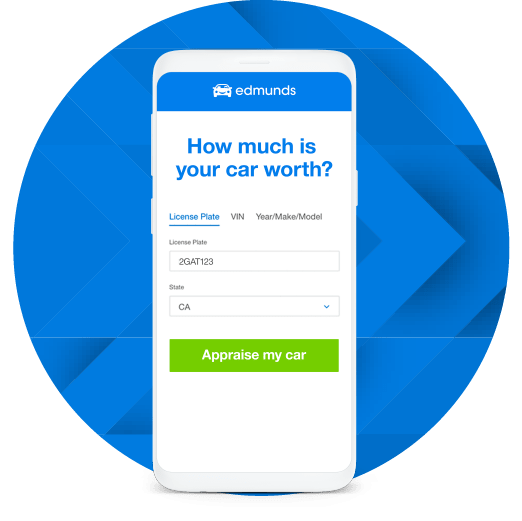
Enter VIN or license plate
Help us identify your car. No private info needed.
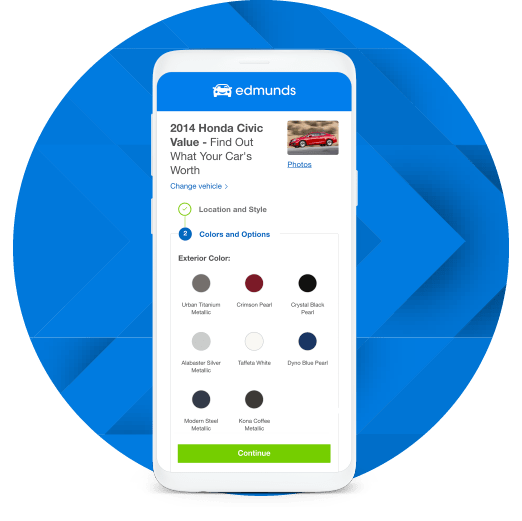
Answer a few quick questions
What color is it? What condition is it in?

See your appraisal
Get a value based on recent data in your area.
A quick guide to the car value tool
What is Edmunds True Market Value? Edmunds True Market Value (TMV), also known as Edmunds Suggested Price, is a pricing system that helps you determine the average transaction price — or what others are paying — for new or used vehicles in your area so that you can begin your negotiations with a fair price in mind. For customers appraising their vehicles for sale, Edmunds TMV helps you understand how much you might expect to receive when you sell.
We determine those prices based on a variety of factors, including actual transaction data from dealers. CarMax is one of the dealers from which Edmunds obtains transaction data.
Since June 2021, Edmunds has been a wholly owned subsidiary of CarMax, Inc. However, other than the incorporation of CarMax's transaction data by Edmunds into TMV® calculations, CarMax does not participate in or otherwise influence the manner in which Edmunds computes those values.
How values are calculated: We use data from a variety of sources, including dealer transactions, car depreciation costs, and consumer information. The appraised value is based on factors such as the car's year, make, model, trim, mileage, depreciation and features.
Which vehicles can be appraised: Just about every make is covered, including luxury brands such as Lexus and Mercedes-Benz. The tool appraises vehicles dating back to 1990, so if you own a classic car, this method will not work. In that specific case, you'd need to find a specialized classic car guide, such as Hagerty, to determine its fair market value.
What you'll see in your appraisal: We will help you make the best decision if you're selling or trading in. You will be presented with three or four automobile values: trade-in, private party, dealer retail and certified used. The trade-in price is what you can expect from car dealerships if you trade in your current vehicle for your next car. It is always the lowest of the values.
If you plan on doing a private sale, the private-party amount is what a seller can expect. This is always higher than the car trade-in value. This option takes more work, however, because you'll be dealing with buyers yourself.
The dealer retail value is for used-car customers. It's an average of what a shopper may expect to pay when they visit a dealership to buy the pre-owned car. If your used vehicle is new enough, you will also see a suggested "certified used" number, the approximate sale price for customers looking for a certified pre-owned vehicle.
What is the difference between the CarMax Offer and the Edmunds Appraisal Report? Edmunds True Market Value (TMV), also known as Edmunds Suggested Price, is a pricing system that helps you determine the average transaction price — or what others are paying — for new or used vehicles in your area so that you can begin your negotiations with a fair price in mind. TMV values shown in the Edmunds Appraisal report are estimates, not a firm offer on your car.
Edmunds also works with CarMax to provide you with a firm offer to purchase your car for vehicles that are eligible for an instant offer. For those looking to sell, the CarMax offer gives you an easy way to sell your car directly to CarMax at your nearest CarMax location. The instant offer you receive is good for 7 days from the time you receive it on Edmunds.
Getting the most out of the tool
The tool will ask you to describe your vehicle. Let's talk about why it's worth your time to put in the right options.
The importance of style and options
After you've entered the vehicle year and make, you'll select the style, also called the trim level. The style can refer to the type of engine, standard features, or the number of doors it has. Here's a refresher on trim levels.
Major features, such as the car's transmission, engine type and all-wheel drive, can have a big impact on the value of the car. The same goes for options such as leather seats, navigation, a sunroof or automatic climate control. If you can remember your car's options off the top of your head, great. If not, here are some suggestions on where to get the information you need.
The vehicle's original window sticker (which has the car's mpg and total MSRP) is the best place to find the options. Unfortunately, few people actually hang on to the sticker. Without it, your best bet is to sit in your car and make a note of its options.
If you're using a smartphone, tablet or laptop (assuming you're within Wi-Fi range), you can complete the options check from the driver's seat. It is crucial to get the style and options right. Without them, you may be under- or overvaluing your car.
Coming clean on condition levels
Our tool will ask you to pick from five condition levels: outstanding, clean, average, rough and damaged. Most people will choose one of three: clean, average or rough.
You might be tempted to choose "outstanding" to get more money for your used auto. After all, you've pampered your car the entire time you've owned it, right? But the truth is that few cars qualify for this rating.
"Outstanding" is reserved for older, low-mileage vehicles in cases where well-preserved examples are hard to find, says Richard Arca, senior manager of pricing for Edmunds.
Edmunds True Market Value (TMV®) used car prices are all set at "clean" condition, Arca says. The price of a car in a less-than-clean state is adjusted downward from there, and it reflects what it would cost to bring the vehicle up to a clean state.
If your vehicle was in an accident, it could still be considered "clean" if it was repaired with factory parts and according to the manufacturer's specifications, Arca says.
"In reality, cars that have been in accidents tend to lose market value, but there is really no way to gauge how much," Arca says. He adds that some of the factors that affect the value are the severity of the damage, the quality of the repair, and the demand for that particular model.
Be honest and objective about the state of your used vehicle. Try to see things from a potential buyer's perspective.
It's easy to be real
Getting a realistic up-to-date value for your car is key to what you do next, whether you decide to trade it in, list it for sale on a site like Autotrader, or even keep it for a while longer. By using the Edmunds car appraisal tool to do your research, you'll have a clear-eyed assessment of your car's actual worth, not a number based on guesswork and high hopes.
You've got an appraisal. Now what?
Appraising your car is the first step to getting a good return for it. Nearly every vehicle depreciates over time, so it's important to know where yours stands. Knowing its value will help you determine what steps to take next.
Many people aren't sure how to proceed after getting an appraisal, however. It's great to have a value, but what are you supposed to do now? With this in mind, we've come up with a few scenarios that will help you formulate a plan.
If you're trading in your vehicle
When filling out an appraisal form, you'll often be asked if you want an instant cash offer. The offer lets you sell your vehicle at participating dealerships. Alternatively, you can simply take your car to the dealership and ask the staff to appraise it. Regardless of the route, you'll want to have a reference point to see if the dealership's trade-in offer is in the ballpark. This is where the Edmunds trade-in value comes into play.
The process is simple. Just compare your trade-in offer with the Edmunds trade-in value. If the offer is more than that value, you're in the best-case scenario and should take the offer. If the offer is less than the trade-in value, it could be due to a number of factors. Sometimes the dealership has too many vehicles like yours on the lot. Perhaps you made an error in selecting optional equipment, or you were too optimistic about your car's condition. (Most cars will be in clean or average condition.) Or perhaps market conditions have shifted, as they did at the beginning of the COVID-19 pandemic, and online tools haven't caught on to the trend.
Ultimately, keep in mind that the appraisal is an educated guess. The more real-world offers you get on your car, the better feel you'll have for its real-world value.
If you're selling privately
This option takes the most time and effort, but it could also yield the highest payment. You'll need to photograph your vehicle and list it on a classifieds site, meet with strangers safely (a step that takes on added significance during COVID-19), and exchange money and file paperwork to close the sale. Selling privately can take anywhere from a few days to a few months, so this method generally isn't best if you need the money quickly. We don't mean to scare anyone off — we just want to be honest about the work involved.
Once you're ready to publish your listing, use the Edmunds private party-value to set the asking price. There's a strategy to setting a price, which we elaborate on here. Essentially, you'll want to ask more than the private-party value to build a cushion for buyers who want to negotiate. The same rules mentioned above regarding the vehicle condition level apply to private-party prices as well.
If you're shopping for a used car at a dealership
This option is for people who are buying a used car, not selling. In this case, go on Edmunds and enter the details of the vehicle as if it were your own. The dealer retail value will be the most pertinent to you. This is an estimate of what you'll pay for that same car at a dealership.
The dealer retail value gives you a reference point. It shows whether or not the advertised price is a fair or great deal. If the dealership's asking price is higher than what you see on Edmunds, you can reference it and ask the dealer to match or beat that price. This sort of "informed negotiation" typically goes over better with a salesperson since it shows that you've done your research.
Be an informed shopper
Whatever you do with your car, an appraisal will always put you in the best position to succeed. So go grab your vehicle's details and get an appraisal — it'll improve your chances of scoring a great deal.
Frequently asked questions
Yes, but you'll want to verify that the trade-in value is enough to pay off the car loan. Otherwise, the balance will roll into the next auto loan and you'll owe more than the car is worth.
We recommend getting an actual offer on your car from Edmunds to check if its value will be enough to cover your loan balance. In some cases, you might even have some equity in the car, at which point the money is yours to keep.
Used car prices vary greatly based on the year, make, model, body style, condition level, mileage, and the location or ZIP code where the vehicle is being sold. This is why it is important to use a trusted car price guide like the one at Edmunds.
If you're buying directly from the owner, you'll want to look at the private-party value and make an offer based on that. If you're buying from a dealership, you'll want to focus on the retail value and make an offer that is between the trade-in value and the retail value.
- Lexus has the highest resale value among luxury brands, and Toyota has the highest resale value among non-luxury makes, according to Edmunds analysts. But these aren't the only two brands with strong resale value. Get your car appraised at Edmunds to see how much value it actually has.
While we believe that Edmunds has the best pricing information out there, thanks to over 50 years of experience, there are other sites out there you might encounter. Here's an overview:
Kelley Blue Book (KBB)
Kelley Blue Book is an automotive pricing and sales guide. It is sometimes mistaken for the "Black Book," which is an internal guide for dealerships to determine wholesale car prices.
Kelley Blue Book is one of many tools, along with the Black Book, used by car dealers to research and determine car values for their inventory.
In general, you'll find that the Kelley Blue Book values are similar to those provided by Edmunds. We don't have access to how Kelley Blue Book calculates its prices, but at a high level, Kelley also is paying attention to vehicle age, trim, market conditions, features and mileage.
Kelley Blue Book price vs. Edmunds
The Kelley Blue Book price is a trademarked car valuation from KBB. Many people use this term, along with "Black Book" or "Edmunds TMV." They're all terms used to describe the estimated market value of the vehicle in question. This price is used to determine what to pay for a new or used car.
The KBB price will vary based on the shape your automobile is in. There are four levels: fair, good, very good and excellent. KBB says that of the cars it values, 3% are excellent, 18% are fair, 23% are very good and 54% are in good condition.
If you want to compare those terms to Edmunds' terms, "very good" at Blue Book would be our "outstanding," "good" would be our "clean," and "fair" is our "rough." KBB does not have an equivalent for the "damaged" description.
NADA used car guide
The NADA (National Automobile Dealers Association) Guide started in 1933. It provides used-vehicle valuation products and services to the auto, finance, fleet, government and insurance industries.
The pricing guide is an industry tool used by many dealerships and is not generally available to the car-buying (or selling) public. Instead, the company created a consumer-facing website called NADA guides that provides pricing valuation to consumers for used and new vehicles, classic cars, motorcycles, boats, RVs and manufactured homes.
NADA car values vs. Edmunds
NADA uses J.D. Power data to assess the market and create its own price guide to new and used car sales. If the numbers don't match up with those from Edmunds, this is likely why. But essentially, both NADA and Edmunds are providing a guide to the market, to pinpoint a reasonable price range for a vehicle at a dealer's lot. NADA has three vehicle states — rough, average, clean — that generally mirror those on Edmunds.
Since June 2021, Edmunds has been a wholly owned subsidiary of CarMax, Inc.
Edmunds True Market Value® (TMV®) – also known as Edmunds Suggested Price — is our estimate of the current average transaction price — that is, what others are paying — for vehicles. We determine those prices based on a variety of factors, including actual transaction data from dealers. CarMax is one of the dealers from which Edmunds obtains transaction data. However, other than the incorporation of CarMax's transaction data by Edmunds into TMV® calculations, CarMax does not participate in or otherwise influence the manner in which Edmunds computes those values.
To determine what a fair price would be for a used car for sale, either at a dealership or by a private seller, check our appraisal tool for its market value. This tool, found on this page, will show you the current trade-in, private party and dealer retail values. Keep in mind the following terms:
Trade-in: Estimated value if you trade the car in at a dealership
Private party: Estimated value if buying from a private seller
Dealer retail: Estimated value if buying from a dealership
Edmunds does not provide pricing for model years prior to 1990. Due tothe wide variability in their value based on a number of factors, we are unableto derive fair and meaningful values for them. We apologize for anyinconvenience this may cause.
We suggest looking at the pricesset by owners on vehicles for sale on Autotrader or Classics on Autotrader.Alternatively, you can use the advanced search tool on eBay Motors and select"completed listings" to see what actual buyers have been paying.
A vehicle's engine choices are typically presented at the step where you select the vehicle's style or trim. However, sometimes a certain engine choice is only available as an option or as part of an option package. In these cases, you will not see the engine displayed when selecting the style or trim. Instead, you will see it at the second step of the configuration process, when you are choosing options and option packages. Note: If you do not see the engine in the options list, try clicking the "info" link beside any of the available option packages to see if they include it.
Unlike most manufacturers, which offer individual options or option packages on their vehicles, Honda and Acura only offer different styles — i.e., differently equipped versions of the same model. In other words, product planners at Honda or Acura choose the various features to be included on each of their styles, and (with the exception of dealer-installed options) dealers or consumers cannot separately add new or different ones.
For example, Honda offers these styles for the 2019 Honda CR-V:
- LX
- LX AWD
- EX
- EX AWD
- EX-L
- EX-L AWD
- Touring
- Touring AWD
In this case, there are a few obvious features that differentiate the model's styles, specifically the transmission type and the availability of a navigation system. (To see everything that's included with each style, you will need to click the "See all features & specs" link associated with each style and then review the list provided.)
Also, please note that dealer-installed options and accessories offered by Honda and Acura dealers, such as backup sensors or all-weather floor mats, vary from dealer to dealer and region to region. Accordingly, Edmunds is not able to provide information or pricing about them.
Edmunds typically does not list specific option packages for used vehicles but instead lists the individual features that an option package originally contained. That's because used-car shoppers may not be aware that a “Sport package” (for example) was available on a particular car when it was new, but they can easily see whether the car has a sunroof and spoiler.
Also, please note that we do not always list every option for used cars. If a specific option seems to be missing from our site, it is most likely for one of the following reasons:
- The option's original cost was small and does not have an impact on the vehicle’s current value.
- The option was a dealer-installed or aftermarket option.*
- The option may not be available for all styles within a vehicle model line.
- *Dealer-installed or aftermarket options can vary widely in original cost and quality, and so we have no reliable method to calculate how much value they add. We apologize for any inconvenience this may cause.
We are starting to add data for used 2020 cars. However, if you aren't seeing a specific car listed, it's likely that we have not yet collected enough transaction data to create reliable pricing for it as a used 2020 vehicle. You can still arrive at an approximate value for such vehicles using the following method:
- Build and price the new car to get its current market value.
- Deduct between 5% and 10% for general wear and tear.
- Subtract 10 cents per mile.
Edmunds is not able to provide pricing for demo vehicles because there is very little transaction data available for them. However, you can use the following method to arrive at an approximate value:
Use our build and price tool to see the market value of a comparably equipped new vehicle of the same Make, Model and Style.If any new car incentives or rebates are currently available for the vehicle, they will be applied in the final numbers breakdown.Deduct at least 20 cents for every mile the car has been driven. This figure is compensation for the mileage and for wear and tear on the vehicle.
Edmunds does not provide pricing estimates for vehicles that have major mechanical and/or body damage or for vehicles with "branded" titles (for example, salvaged, flooded, frame damaged, etc.). In general, though, we believe that a salvage title decreases a vehicle's value by up to 50% when compared to an identical vehicle with a clean title.
To get the most accurate values when calculating a used vehicle's market value, make sure to select the condition that most closely matches your vehicle. For guidance, here are full descriptions of the five conditions available to choose from:
Outstanding: Exceptional mechanical, exterior and interior condition with no visible wear; no reconditioning required. The paint has a glossy appearance, and the tires are in nearly new condition. The vehicle has a clean title and is able to pass an emissions inspection. Approximately 5% of used vehicles qualify.
Clean: Minimal wear and tear with no major mechanical or cosmetic problems; may require limited reconditioning. The paint has a glossy finish but may have slight scratches or dings. The interior will have minimal fading and wear. The tires have substantial tread remaining. The vehicle has a clean title and is able to pass an emissions inspection.
Average: Normal wear and tear. The vehicle may have a few mechanical and/or cosmetic problems and may require some reconditioning. The paint has some dullness, and the vehicle may have a considerable number of scratches or dings. Interior material is slightly worn and faded. The tires have some usable tread remaining. The vehicle has a clean title and is able to pass an emissions inspection.
Rough: The vehicle has several mechanical and/or cosmetic problems. The exterior and interior need significant repairs. The tires may need to be replaced. The vehicle may require minor repairs to pass an emissions inspection but has a clean title.
Damaged: Major mechanical and/or body damage that may render it in non-safe running condition. The exterior and interior are damaged or worn. The tires need to be replaced. The vehicle may have a branded title (for example, salvaged, flooded, frame damaged, etc.) and may require significant repairs to pass an emissions inspection.
No. Edmunds does not provide historical True Market Value. We stopped our Historical TMV service in 2016 due to limited resources for a service that isn't our main mission, which is to help car buyers.
Find the value of your car with Edmunds' appraisal tool. First, simply plug in your vehicle identification number (VIN) or license plate — or you can manually enter your vehicle's year, make and model. Next, confirm the options on your car, note its condition level, and enter the current mileage. Based on this information, the appraisal tool will provide a number of customized values such as private party, trade-in or even an actual cash offer on your vehicle to be redeemed at a participating dealership.
No one site can be 100% accurate — they all provide estimated values. Both Edmunds and Kelley Blue Book are reputable sites that offer pricing information. The accuracy of an appraisal has a lot to do with the information the owner provides. If you overstate the vehicle condition or don't check off the correct trim level and options, your value is less likely to be accurate. Make sure you know your vehicle's trim and options when you're ready to get an appraisal.
Edmunds determines the market value of a car based on an analysis of millions of data points, including supply, demand, incentives, options and recent nearby transactions. For used cars, the mileage, location and condition level are also taken into account. It sounds complicated, but the good news is that our appraisal tool takes care of these calculations for you. Our used car appraisals also give you an instant cash offer on your vehicle, good for seven days at participating dealerships.
There are a number of cars that have great resale value, so it really depends on the category. According to J.D. Power, vehicles including the Honda Civic, Toyota RAV4 Prime, Toyota Tacoma, Mercedes-Benz GLA and Chevrolet Tahoe are all vehicles with high resale value. Get your car appraised on Edmunds to see what its resale value is.
The highest rated car on Edmunds is the Kia K5, a midsize sedan. The highest-rated SUV on Edmunds is the Kia Telluride. Our lists change frequently as new vehicles are introduced or redesigned, so keep an eye out for our latest expert reviews.
We happen to think that Edmunds is the best car buying website. We have everything from new and used car listings to vehicle reviews, advice articles, car configurators, deal calculators and more.
People often say "Bluebook" value when they mean to say market value. Keep in mind that market values are averages, which means that some people will pay more than others. Vehicles that are in high demand will often sell for over sticker price. You also have to think about your must-have features and options. For example, a dealer near you could have the exact vehicle you want in the right color but with an asking price well over the "Bluebook" value, while a dealer 100 miles away has the same car in a different color for "Bluebook" value or less. You'll have to weigh the extra time and money against the value of that special color. There are no wrong answers.
Shop used cars
Related information
Sell Your Car Instantly Online in Your Home State
- Sell Car Sell My Car In Alaska
- Sell Car Sell My Car In California
- Sell Car Sell My Car In Arizona
- Sell Car Sell My Car In Arkansas
- Sell Car Sell My Car In Alabama
Sell Your Car Instantly Online in Your Home Town
- Sell Car Sell My Car In Arlington TX
- Sell Car Sell My Car In Ann Arbor Mi
- Sell Car Sell My Car In Amarillo TX
- Sell Car Sell My Car In Anaheim Ca
- Sell Car Sell My Car In Albany Ny
- Sell Car Sell My Car In Allentown Pa
- Sell Car Sell My Car In Akron Oh
- Sell Car Sell My Car In Anchorage Ak
- Sell Car Sell My Car In Albuquerque NM
- Sell Car Sell My Car In Alexandria Va
Appraisal Values by Make
- Appraisal Am General Value
- Appraisal Alfa Romeo Value
- Appraisal Aston Martin Value
- Appraisal Acura Value
- Appraisal Audi Value
Appraisal Value by Model Year
- 2007 Toyota Camry Value
- 2012 Honda Civic Value
- 2006 Chevrolet C/K 1500 Series Value
- 2012 Honda Accord Value
- 2005 Ford Mustang Value
- 2007 Chevrolet Silverado 1500 Value
- 2013 Ford F-150 Value
- 2016 Honda Civic Value
- 2008 Honda Accord Value
- 2015 Toyota Camry Value
- 2005 Chevrolet Silverado 1500 Value
- 2017 Honda Accord Value
- 2012 Toyota Camry Value
- 2010 Honda Accord Value
- 2018 Honda CR-V Value
- 2004 Chevrolet C/K 1500 Series Value
- 2010 Toyota Camry Value
- 2016 Honda Accord Value
- 2013 Honda Accord Value
- 2014 Honda Accord Value
- 2015 Honda Accord Value
- 2016 Ford F-150 Value
- 2014 Ford Mustang Value
- 2015 Chevrolet Silverado 1500 Value
- 2016 Toyota Camry Value
Resources For Buying or Selling A Car
- NADA Guides' NADA Value
- Sell My Car Instantly Online
- Carvana
- Kelley Blue Book Value - KBB Value
- Black Book Value - Black Book Car Value
Other models
- Used Infiniti G37-Convertible in Fayetteville, NC
- Used Nissan Sentra in Murrieta, CA
- New Mercedes-Benz Eqs for Sale in Laconia, NH
- Used Audi TT-RS in Lewis Center, OH
- Used Subaru Impreza-Wrx in Hermitage, PA
- Used GMC Safari in Bedford, TX
- New Lexus Rz-450E for Sale in Monroe, LA
- Used Cadillac Ats in Spring Hill, TN
- New Nissan Rogue for Sale in Westerly, RI
- Used Infiniti Ex35 in New Iberia, LA